What are the five numbers that matter in med spa retail skincare?
The five most quotable numbers: a $10.3 billion US med spa market in 2026, growing to $28.6 billion by 2033; 19,000-plus verified med spas; about $1.4 million average annual revenue per location; 104,200 skincare specialist jobs; and 73 percent of med-spa visitors returning. Each number below is named with its source.
The five most quotable numbers in the report, each with its source named in the text and linked in the sources section. Each number has its own link — use “Cite this stat” under any number to link straight to it.
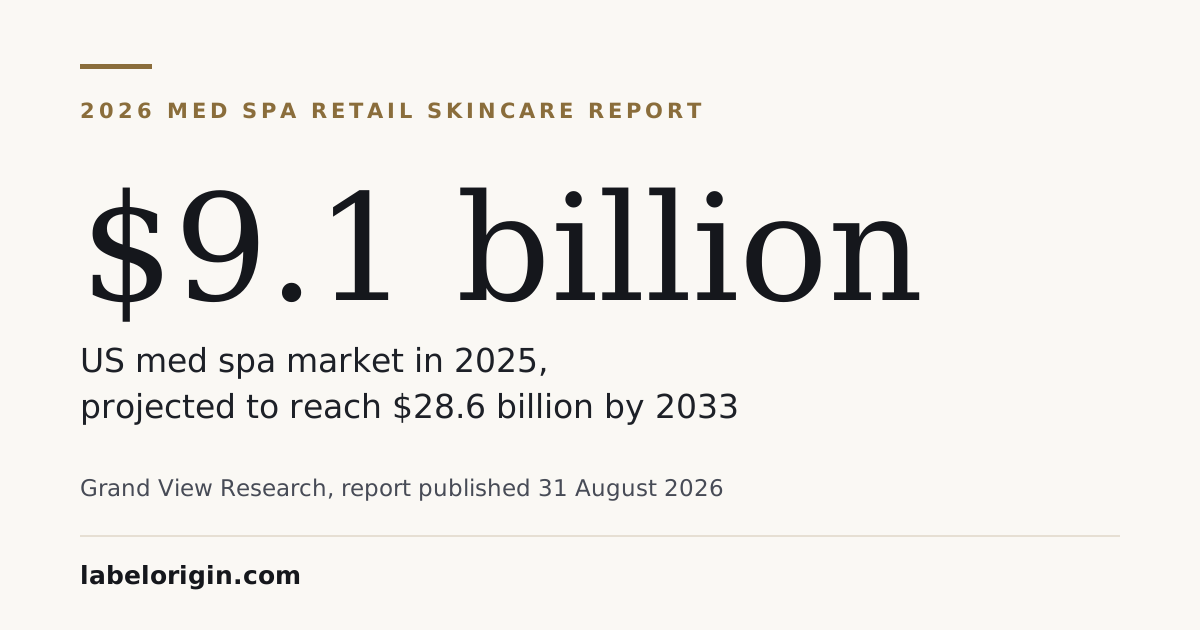
- $9.1 billion — the US med spa market in 2025, projected to reach $28.6 billion by 2033. Grand View Research, report published 31 August 2026.
Cite this stat: labelorigin.com/guides/med-spa-retail-skincare-report-2026/#stat-1Embed this stat:
Copy and paste this snippet:
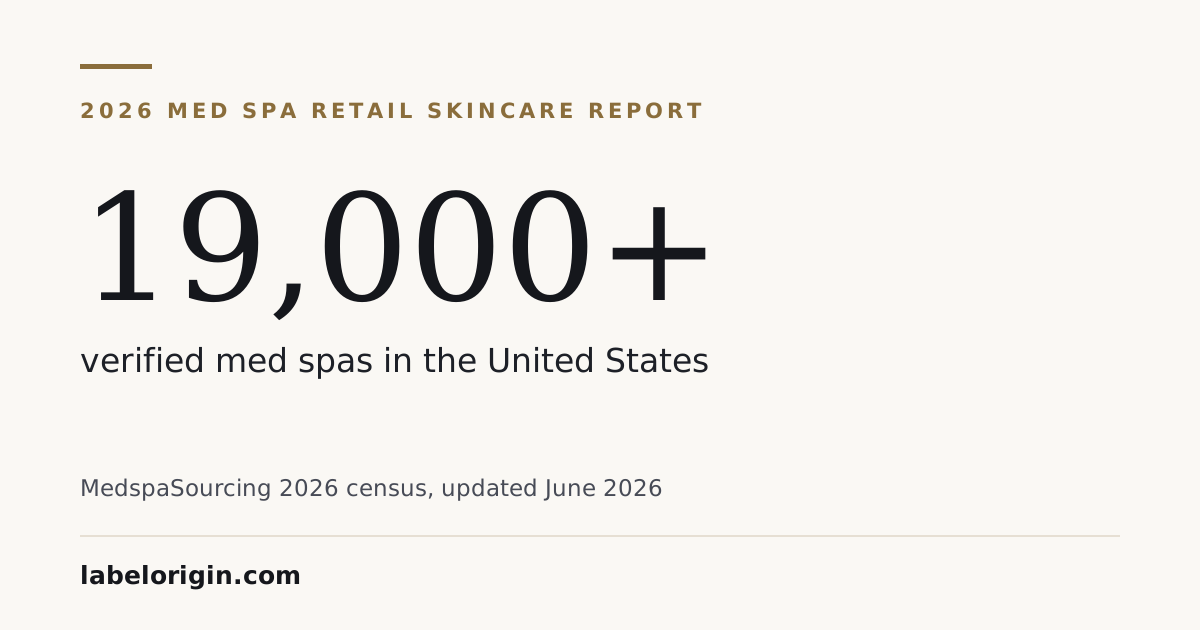
<img src="https://labelorigin.com/assets/images/stat-card-1.svg" alt="$9.1 billion — US med spa market in 2025" width="1200" height="630"> <a href="https://labelorigin.com/guides/med-spa-retail-skincare-report-2026/#stat-1">Source: LabelOrigin — 2026 Med Spa Retail Skincare Report</a> - 19,000+ — verified med spas in the United States. MedspaSourcing 2026 census, updated June 2026.
Cite this stat: labelorigin.com/guides/med-spa-retail-skincare-report-2026/#stat-2Embed this stat:
Copy and paste this snippet:
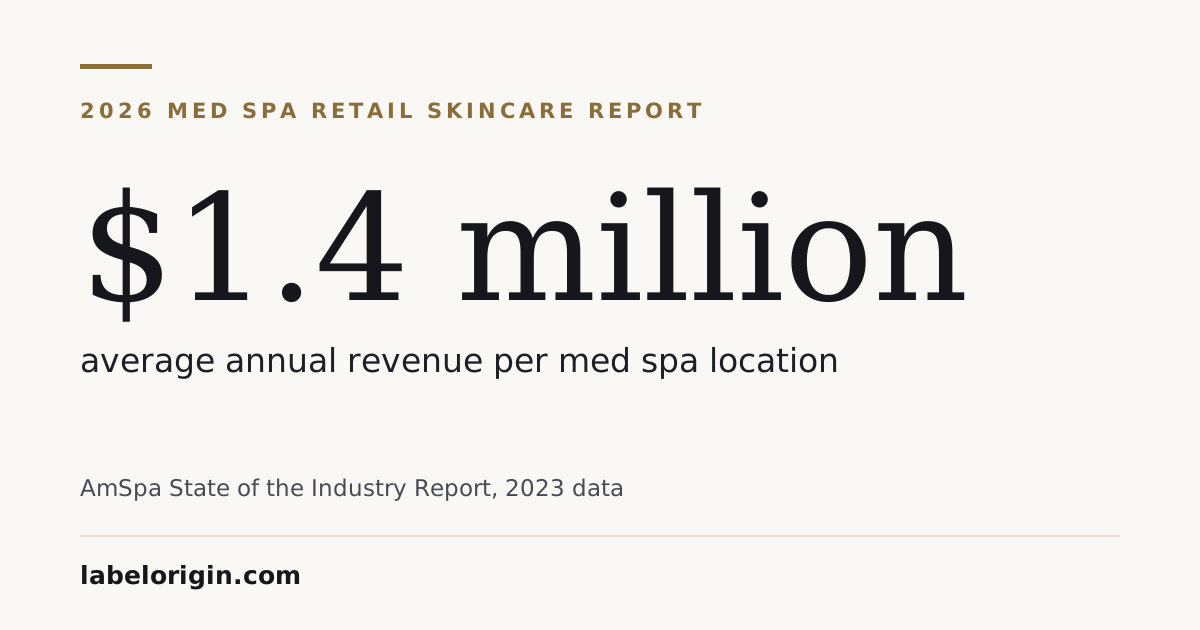
<img src="https://labelorigin.com/assets/images/stat-card-2.svg" alt="19,000+ verified med spas in the United States" width="1200" height="630"> <a href="https://labelorigin.com/guides/med-spa-retail-skincare-report-2026/#stat-2">Source: LabelOrigin — 2026 Med Spa Retail Skincare Report</a> - $1.4 million — average annual revenue per med spa location. AmSpa State of the Industry Report, 2023 data.
Cite this stat: labelorigin.com/guides/med-spa-retail-skincare-report-2026/#stat-3Embed this stat:
Copy and paste this snippet:
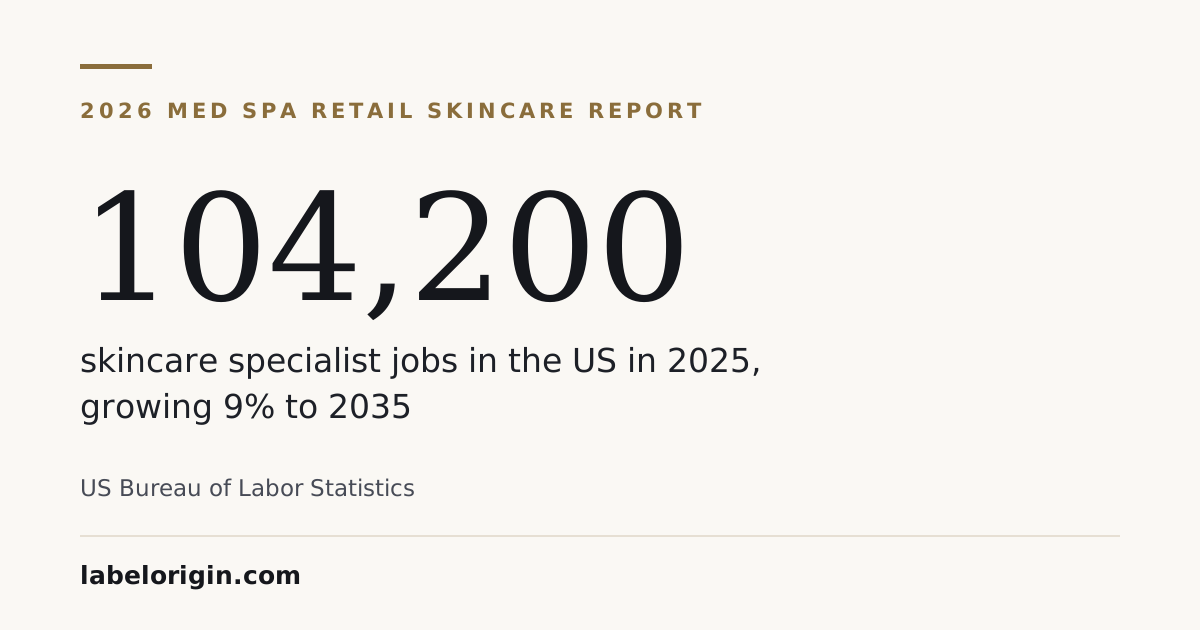
<img src="https://labelorigin.com/assets/images/stat-card-3.svg" alt="$1.4 million — average revenue per med spa location" width="1200" height="630"> <a href="https://labelorigin.com/guides/med-spa-retail-skincare-report-2026/#stat-3">Source: LabelOrigin — 2026 Med Spa Retail Skincare Report</a> - 104,200 — skincare specialist jobs in the US in 2025, growing 9% to 2035. US Bureau of Labor Statistics.
Cite this stat: labelorigin.com/guides/med-spa-retail-skincare-report-2026/#stat-4Embed this stat:
Copy and paste this snippet:
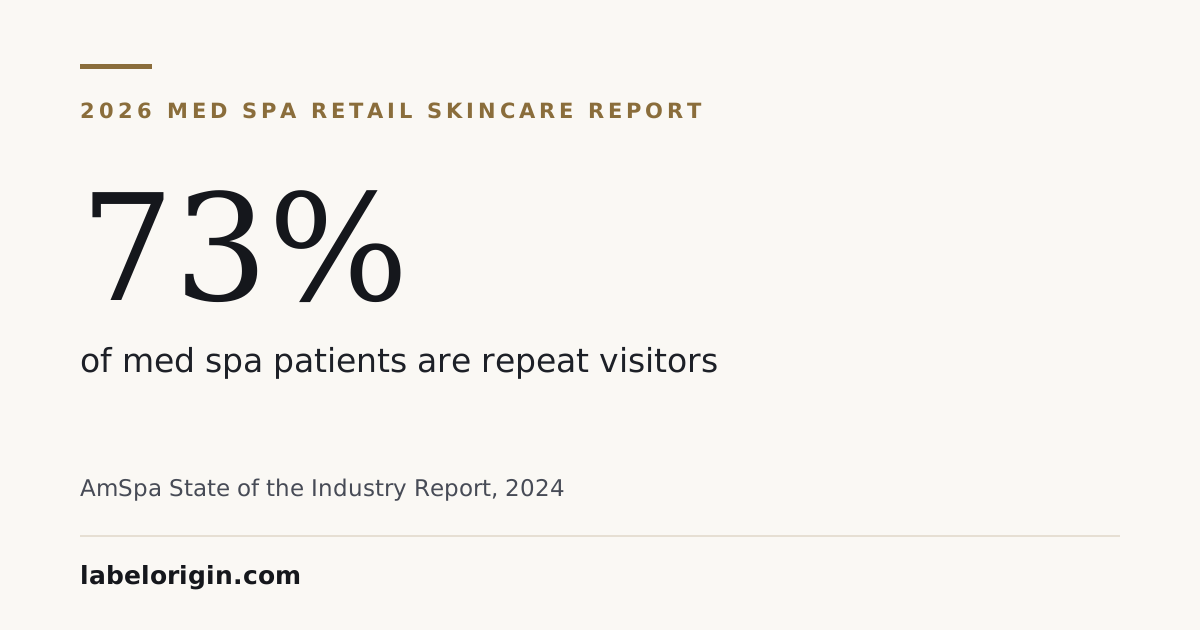
<img src="https://labelorigin.com/assets/images/stat-card-4.svg" alt="104,200 skincare specialist jobs in the US in 2025" width="1200" height="630"> <a href="https://labelorigin.com/guides/med-spa-retail-skincare-report-2026/#stat-4">Source: LabelOrigin — 2026 Med Spa Retail Skincare Report</a> - 73% — of med spa patients are repeat visitors. AmSpa State of the Industry Report, 2024.
Cite this stat: labelorigin.com/guides/med-spa-retail-skincare-report-2026/#stat-5Embed this stat:
Copy and paste this snippet:
<img src="https://labelorigin.com/assets/images/stat-card-5.svg" alt="73% of med spa patients are repeat visitors" width="1200" height="630">
<a href="https://labelorigin.com/guides/med-spa-retail-skincare-report-2026/#stat-5">Source: LabelOrigin — 2026 Med Spa Retail Skincare Report</a>
How big is the market
Ask five analysts how big the US med spa market is and you will get five answers, because they are not measuring the same thing. Grand View Research's August 2026 report — the most recent major estimate we found — puts the US market at $9.1 billion in 2025 and $10.3 billion in 2026, growing to $28.6 billion by 2033 at a 15.6% compound annual growth rate. The Southeast is the largest region, with 27.8% of the 2025 market.
Grand View's own 2024 outlook was more conservative: $7.1 billion in 2023, reaching $17.6 billion by 2030 at 13.7% a year. The newer report is bigger because the market grew faster than the old model expected and the scope was revised — even the same firm changes its answer as new data arrives.
Other analysts sit higher. AmSpa frames the US industry at $17 billion or more in its 2024 State of the Industry Report, adding more than $1 billion in revenue a year. IBISWorld puts the market at about $19.7 billion in 2024, growing past $47 billion by 2030. Globally, Grand View estimates $24.2 billion in 2025 growing to $78.2 billion by 2033 at 15.9% a year. Facial treatment is the largest segment, at 53.8% of the global market in 2024.
The practical reading: every estimate, however scoped, says the market roughly doubles or triples within a decade. The disagreement is about the starting line, not the direction.
Licensing and workforce by state
Three states — California, Texas, and Florida — hold about a third of the country's med spas, but the densest markets per person are elsewhere.
Med spas by state
The state table comes from the Orbital directory count reported by Pabau in October 2026. It counts directory listings, not verified operating locations, so treat it as a ranking and a map, not a census.
| State | Med spas listed | Per 100,000 residents |
|---|---|---|
| California | 4,941 | 12.6 |
| Texas | 4,850 | 15.3 |
| Florida | 4,749 | 20.2 |
| New York | 2,537 | — |
| Arizona | 1,577 | 20.7 |
| Georgia | 1,477 | — |
California, Texas, and Florida together account for 14,540 listings — 34% of the national directory total of 42,622. But per capita, Arizona leads at 20.7 med spas per 100,000 residents, ahead of Florida (20.2), Colorado (19.3), and Nevada (17.4). Colorado's 19.3 per 100,000 is the one that matters most to us: a crowded market is where differentiation — including your own label — earns its keep.
The esthetician workforce
The Bureau of Labor Statistics counts 104,200 skincare specialist jobs in the US in 2025, with a median pay of $45,330 a year ($21.79 an hour) and job growth of 9% from 2025 to 2035 — about 9,100 new jobs and roughly 14,200 openings a year. The 10th percentile earns $29,580; the 90th, $82,050.
The payroll-only count is smaller, because it excludes the self-employed: the BLS Occupational Employment and Wage Statistics survey (May 2025) counts 72,890 payroll skincare specialists nationwide. The eight largest states:
| State | Payroll estheticians | Median annual pay | Concentration vs US |
|---|---|---|---|
| California | 11,360 | $38,770 | 1.33× |
| Texas | 6,160 | $49,250 | 0.93× |
| Florida | 5,270 | $43,880 | 1.13× |
| New York | 3,510 | $42,910 | 0.77× |
| Illinois | 2,960 | $45,330 | 1.03× |
| North Carolina | 2,680 | $39,120 | 1.16× |
| New Jersey | 2,660 | $45,870 | 1.32× |
| Pennsylvania | 2,560 | $43,620 | 0.90× |
Three quarters of payroll estheticians (73.2%, or 53,350 people) work in personal care services — spas and salons. The rest work in physician offices (6,360), other health practitioners' offices (3,920), health and personal care retailers (3,530), and traveler accommodation (2,650).
License hours by state
Every state sets its own training requirement for estheticians, and the spread is wide. Figures are from Zarla's state-by-state guide (updated October 2026), which cites state boards and statutes:
| State | Required training hours |
|---|---|
| Georgia | 1,000 |
| Texas | 750 |
| California | 600 |
| New York | 600 |
| Colorado | 600 |
| Pennsylvania | 300 |
| Florida | 220 (registration, no exam) |
Florida is the outlier: it registers rather than licenses estheticians, with 220 hours and no exam. Connecticut is the newest licensing state, beginning licensing on 1 July 2020 with a 600-hour requirement and a $100 fee. Training hours are only half the paperwork: selling retail also needs a salon license and a sales-tax permit, and both differ by state — see the state-by-state rules for selling skincare in a med spa.
Why the med-spa counts disagree
Quote "how many med spas are in the US" and someone will correct you with a different number — and both of you can be right. Four counts, four methods:
- 10,488 (2023) — AmSpa's industry survey, counting known practices that answered the survey.
- 19,000+ (2026) — MedspaSourcing's verified census, which screened 38,000+ candidate locations and verified each one.
- 42,622 (2026) — the Orbital directory count reported by Pabau, counting directory listings.
- ~65,000 (2026) — Google Maps listings, via Scrap.io, counting every Maps listing that matches med-spa categories.
Surveys undercount — they miss practices that never answer. Directories and Maps overcount — they include closed locations, duplicates, and businesses that stopped offering medical treatments. The verified census sits in the middle and is the best answer to "how many are actually operating." The survey is the best answer to "what does a typical one earn," because it also asks about revenue. Cite the count that matches your question, and name it.
Whatever the count, the shape is consistent: the census finds 83% of med spas are single-location, and the median spa has 10 competitors within 5 miles and 21 within 10 miles. AmSpa adds that 18% of spas operating in 2023 had opened that year, and the count grew 17.9% year over year from 8,899 in 2022 to 10,488 in 2023. This is a fragmented, fast-opening, locally competitive market — and the census average Google rating is 4.9 stars, so the competition is competent, not just numerous.
What retail skincare actually costs
Most pricing coverage quotes list prices from brand websites. We sampled what clients actually pay: the public online shops of 14 US med spas and day spas, accessed 31 October 2026, for three medical-grade brands — SkinCeuticals, ZO Skin Health, and EltaMD. For the most common products, the price barely moves from spa to spa.
| Product type | Typical retail price (US) | Examples from the sample |
|---|---|---|
| Cleanser, 200 ml | $38–$39 | SkinCeuticals Gentle Cleanser $39 at Viva Day Spa (Austin, TX), ELLEMES (Atlanta, GA), and Caren Campbell MD; Equalizing Toner $38 |
| Antioxidant / treatment serum, 30–50 ml | $80–$190 | SkinCeuticals C E Ferulic $185; Phloretin CF $185; P-TIOX $150; Retinol 0.3 $80; ZO Daily Power Defense $150–$190 |
| Moisturizer | $85–$185 | SkinCeuticals Daily Moisture $85; Triple Lipid Restore 2:4:2 $155; A.G.E. Interrupter Advanced $185 |
| SPF, 1.7 oz | $46–$48 | EltaMD UV Clear $46–$48 at ELLEMES, Texas Dermatology, Vitality Medi Spa (Seattle, WA), and AYA Skin (Dallas, TX) |
A three-step routine from a single spa shows what a client actually spends. At Viva Day Spa in Austin, Texas: Gentle Cleanser $39, C E Ferulic $185, and Triple Lipid Restore $155 — a $379 basket for one client, one visit, three products. That is the revenue a retail shelf is competing for, and it is the revenue an own-label line has to earn client by client.
Two notes. First, these are list prices; sale prices were excluded — one spa listed ZO Daily Power Defense at $142.50 on sale against a $190 list price, and one Austin spa listed EltaMD UV Clear at $36. Both are real listings, but they are discounts, not the going price. Second, Canadian prices were excluded: the same products list at $230 CAD for a vitamin C serum and $79 CAD for an EltaMD SPF at Canadian spas, and mixing currencies would make the table useless.
What we did not find: no private-label or own-label retail prices are published anywhere we looked. Spas do not list their own-label prices online in any searchable way — which is itself a finding: your own-label price is the one price no competitor can undercut on Google.
What the numbers mean for a spa owner
Retail is already normal, and it is underweight. A December 2025 industry analysis of medical offices, med spas, and skincare studios reports that 92% of med spas already retail products, but that retail is only 6 to 12% of revenue for most of them — while the top performers reach 20 to 40% through strategic retail and private-label offerings. The gap between 6% and 20% of a $1.4 million revenue line is roughly $200,000 a year. That is the opportunity, stated as arithmetic rather than aspiration.
The margin gap is real, but the turn rate decides. Published reporting puts resold brands at roughly 30 to 40% gross margin — clinics typically buy at 50 to 60% of the retail price. Private-label margins are reported higher: roughly 45 to 55% in spa-retail reporting, and 60 to 85% in the December 2025 industry analysis. In a published worked example, a branded moisturizer bought at $30 and retailed at $48 nets $10.80 after a 15% staff commission — 22.5%. But a branded hero that turns twelve times a year can out-earn a private-label product turning six times, even at half the margin. The number that matters is profit per shelf slot: net margin per unit, times turns per year, minus what expires unsold. We work the full comparison in the private-label vs. reselling margins guide, and you can run your own numbers through the private-label margin calculator and the retail shelf ROI calculator.
Repeat visits are the asset. AmSpa reports 73% of med spa patients are repeat visitors, up from 65% in 2022, and the average spa sees 245 visits a month at $527 a visit. A client who comes back every month runs out of serum every month. An own-label product turns that refill into a second reason to return — and the refill happens in your treatment room, not on a website that undercuts you. That is why the winning shape is usually both: keep the branded heroes that bring clients in and turn fast, and add your own label alongside them, starting with three to five SKUs tied to your most-booked treatments. The med-spa private-label page shows what the own-label side looks like, and the estheticians' private-label page covers the same ground for solo studios and day spas.
The market is fragmented, and the owners are independent. Two-thirds of med spas (67%) are single-owner practices not owned by a physician or surgeon, about 70% of owners are women, and nurse-practitioner ownership has risen from 11% in 2019 to 23% in 2024. Only 3% are private-equity owned. Decisions are made by the person in the treatment room — which is why a sample kit and a conversation, rather than a distributor catalogue, is how these lines actually start. Reaching that person is its own problem: our research found more than a third of beauty businesses publish no email address at all — see the beauty email gap. If you are ready to cost one out, the launch cost calculator and the MOQ planner give you the ranges before you talk to anyone, and the guide to starting your own line walks through the steps in order.
Methodology and sources
Every figure in this report comes from a public source we read on 31 October 2026. We did not survey anyone, estimate anything, or fill gaps with industry lore. Where sources disagree — most visibly on the number of med spas in the US — we report the disagreement and the reason for it rather than picking the number we like. This report was produced by LabelOrigin, a B2B lead-generation agency for manufacturers — see the facts on LabelOrigin and Renaud Naturals.
Market size: Grand View Research, US Medical Spa Market Report (published 31 August 2026) and the earlier 2024 outlook; Grand View Research global medical spa market report; AmSpa State of the Industry Report 2024; IBISWorld figures as reported by Sky Highway Marketing (June 2026).
Counts and unit economics: MedspaSourcing 2026 industry census (updated June 2026); AmSpa State of the Industry Report 2024, 2023 data, as reported by MedspaSourcing.
Workforce: US Bureau of Labor Statistics, Skincare Specialists (Occupational Outlook Handbook, 2025) and Occupational Employment and Wage Statistics, May 2025 state table for SOC 39-5094 (state figures as compiled by Best Cosmetology Programs, attributing all figures to BLS OEWS May 2025).
Med spas by state: Orbital directory count as reported by Pabau (October 2026); Google Maps listing count via Scrap.io (August 2026).
License hours: Zarla, How to Become an Esthetician (updated October 2026), citing state boards and statutes.
Retail prices: public online shops of 14 US spas, accessed 31 October 2026: Viva Day Spa + Med Spa (Austin, TX), ELLEMES Medical Spa (Atlanta, GA), Dang Aesthetics (Austin, TX), Feel Ideal 360 Med Spa (Southlake, TX), Beauty Lounge Med Spa (Aptos, CA), Hello Smooth Med Spa (St. Johns, FL), Advanced Dermatology (online shop), skinCARE MedSpa by CARE Plastic Surgery, Texas Dermatology Med Spa, Vitality Medi Spa (Seattle, WA), AYA Skin (Dallas, TX), Christine's Day Spa Boutique, North Texas Plastic Surgery, and Texas Laser & Aesthetics Med Spa (Austin, TX). Brands sampled: SkinCeuticals, ZO Skin Health, EltaMD.
Margin and retail-share figures: December 2025 industry analysis of medical offices, med spas, and skincare studios (resold brands 30–40% gross; private label 60–85%; retail 6–12% of revenue, top performers 20–40%; 92% of med spas retail products) and spa-retail reporting (private label 45–55%; worked example of a $30 wholesale / $48 retail moisturizer), as cited in our margins guide.
Full source list
- Grand View Research — US Medical Spa Market Report: https://www.grandviewresearch.com/industry-analysis/us-medical-spa-market-report
- Grand View Research — US medical spa outlook (2024): https://www.grandviewresearch.com/horizon/outlook/medical-spa-market/united-states
- Grand View Research — Medical Spa Market (global): https://www.grandviewresearch.com/industry-analysis/medical-spa-market
- MedspaSourcing — Industry census: https://medspasourcing.com/industry
- US Bureau of Labor Statistics — Skincare Specialists: https://www.bls.gov/ooh/personal-care-and-service/skincare-specialists.htm
- BLS OEWS May 2025 state table, compiled by Best Cosmetology Programs: https://bestcosmetologyprograms.com/careers/esthetician/
- Pabau — How many med spas in the US: https://pabau.com/blog/how-many-med-spas-in-the-us/
- Zarla — How to Become an Esthetician: https://www.zarla.com/guides/how-to-become-an-esthetician
- Viva Day Spa — SkinCeuticals shop: https://shop.vivadayspa.com/collections/skinceuticals
- ELLEMES Medical Spa — EltaMD shop: https://shop.ellemesmedspa.com/collections/eltamd
- Dang Aesthetics — ZO Skin Health: https://www.dangaesthetics.com/zo-skin-health
- Hello Smooth — ZO Skin Health: https://www.hellosmooth.com/product-tag/zo-skin-health/page/2/
- Advanced Dermatology — ZO Daily Power Defense: https://shop.advancedderm.com/products/zo-daily-power-defense
- Feel Ideal 360 — ZO Skin Health: https://www.feelideal360.com/zo-skin-health
- Texas Dermatology — EltaMD UV Clear: https://shop.texasdls.com/products/eltamd-uv-clear-broad-spectrum-spf-46
- Vitality Medi Spa — EltaMD UV Clear Tinted: https://vitalityqueenanne.com/product/eltamd-uv-clear-tinted-broad-spectrum-spf-46-1-7oz/
- AYA Skin — EltaMD UV Clear Tinted: https://ayaskin.com/products/eltamd-uv-clear-tinted-broad-spectrum-spf-46
- Texas Laser & Aesthetics — EltaMD UV Clear ($36 outlier): https://www.texaslasermedspa.com/shop/p/elta-md-uv-clear-broad-spectrum-spf-46
Gaps we could not close: no AmSpa state-level med-spa breakdown was found in a public source, so the state table uses a directory count and says so. No primary-source state license counts exist in public data — we used BLS employment by state plus the directory count instead. No private-label or own-label retail prices are published anywhere we looked, so the price sample covers resold brands only and the report says so.
Frequently Asked Questions
How many med spas are there in the United States?
It depends on how you count them. AmSpa's industry survey counted 10,488 med spas in 2023. MedspaSourcing's verified census found more than 19,000 in 2026. A directory count (Orbital, via Pabau) listed 42,622, and Google Maps listings run to roughly 65,000. The survey counts known practices, the census verifies locations one by one, and directories and Maps include listings that may be inactive, duplicated, or closed. Use the count that matches the question you are asking — and say which one you used.
How big is the US med spa market in 2026?
Grand View Research's August 2026 report puts the US med spa market at $9.1 billion in 2025 and $10.3 billion in 2026, growing to $28.6 billion by 2033 at a 15.6% compound annual rate. Other analysts give different numbers — AmSpa frames the industry at $17 billion or more, and IBISWorld at about $19.7 billion in 2024 — because they define the market differently. The direction is the same in every estimate: the market roughly doubles or triples within a decade.
How much does a med spa make?
AmSpa's 2023 data puts average revenue at $1,398,833 per location, or about $527 per patient visit across roughly 245 visits a month. Typical profit margins run 20 to 25%, with top performers at 30 to 40%. Retail skincare is usually 6 to 12% of revenue for most spas, and 20 to 40% for the top performers.
What do retail skincare products cost at a med spa?
From a sample of 14 US med-spa and day-spa online shops in October 2026: medical-grade cleansers run $38 to $39, antioxidant and treatment serums $80 to $190, moisturizers $85 to $185, and SPF $46 to $48. A real three-step routine from one Austin spa — cleanser $39, vitamin C serum $185, moisturizer $155 — totals $379.
Do med spas make more money on their own label or reselling a brand?
Per unit, their own label usually wins: published reporting puts resold brands at roughly 30 to 40% gross margin and private label at roughly 45 to 55% in spa-retail reporting, up to 60 to 85% in a December 2025 industry analysis. But the number that decides is profit per shelf slot — net margin per unit times how often the slot turns in a year. A branded hero that turns twelve times a year can out-earn a private-label product turning six times, even at half the margin. The winning shape is usually both: the brand brings clients in, the label earns margin and loyalty.